Call it the "gamification of Github", but interestingly one of the motivators for me to continue studying a programming language was the little indicator that shows how much activity you have contributed to your projects each day under your account. Without uploading my progress there, I felt a little stifled... Whereas before I could see the progress I had taken each day.
I was thinking how to do it, and decided to just upload the contents of my exercise folder to Github. Mostly as a mark of my own progress, but also for anyone to poke around who might be struggling on the same course, or just looking for alternative solutions, or whatever. At some point I intend to give the full contents human readable comments for each line (at present maybe three quarters of the files are fully commented).
Needless to say, I'm mostly loving the book, and felt the end of the first section of the book (up to exercise 26) was the perfect time to upload my progress so far. Even though most of the information in those exercises I already knew, what sets the course apart is it fully deconstructs each new topic you over over a number of exercises, so you know inside-out how to implement it before moving on. The focus on forcing you to type it rather than just copying and pasting is annoying initially, but it gives me a better understanding of the code line-by-line and what it should look like (although I'll tell a secret, I didn't do things like memorise my own dictionary, it seemed overkill when I was also commenting line-by-line and hadn't run into anything I needed to look up).
Again, the idea of "trying to break the code" seems non-sensical to me, as there are an infinite amount of ways to break it... Trying to aim for collecting many different kinds of errors seems tedious as well. Instead, I've been trying to mod and hack the code with as many of the skills I've learned as possible and still keep it working... e.g. adding lots of user inputs, moving repeated lines of code into functions, doing the same thing a different way with other things I've picked up from my other attempt to learn Python. It seems akin to taking apart an engine and putting it back together in order to learn the mechanics of it- and I think it's great.
My exercises from the course are available on GitHub.. Also, the course I am now following is "Learn Python The Hard Way" by Zed A. Shaw
Showing posts with label Technology. Show all posts
Showing posts with label Technology. Show all posts
Monday, 2 October 2017
Friday, 29 September 2017
Learn Python 3 The Hard Way: Initial Thoughts
I'm on exercise 15 now, and I'm finding I really enjoy it. It's going slow enough that I feel I can write something from scratch from the concepts I've already learned, and actively encourages hacking and breaking the initial code.
My only complaint is I'm not sure I like the snarky attitude of the author. I hope it's meant to be humourous, as I would really despise him as a tutor. It's very right side/black and white/arrogant thinking that seems to permeate some of the web development scene, which discourages questions and discussion and focuses solely on a RTFM approach. It's an approach I feel puts a lot of people off learning programming or getting more involved, as different people have different ways of internalising difficult concepts. He even says himself to not just stare at code but interact with it and print more outputs to diagnose what's wrong rather than just staring at it... And yet tells people to just "do as he says" rather than ask questions, which seems rather hypocritical. Also, on the one hand he chastises experimentation from "actual" questions he has received ("You shouldn't do that and just write it like I originally said"), and yet simultaneously chastises those who haven't taken time to experiment or break the code.
Again, I hope it's meant mostly in jest. Otherwise he really comes across a dick.
I'm still figuring out the best way to integrate the new course with my GitHub, nonetheless, the old work is still available there. Also, the course I am now following is "Learn Python The Hard Way" by Zed A. Shaw
My only complaint is I'm not sure I like the snarky attitude of the author. I hope it's meant to be humourous, as I would really despise him as a tutor. It's very right side/black and white/arrogant thinking that seems to permeate some of the web development scene, which discourages questions and discussion and focuses solely on a RTFM approach. It's an approach I feel puts a lot of people off learning programming or getting more involved, as different people have different ways of internalising difficult concepts. He even says himself to not just stare at code but interact with it and print more outputs to diagnose what's wrong rather than just staring at it... And yet tells people to just "do as he says" rather than ask questions, which seems rather hypocritical. Also, on the one hand he chastises experimentation from "actual" questions he has received ("You shouldn't do that and just write it like I originally said"), and yet simultaneously chastises those who haven't taken time to experiment or break the code.
Again, I hope it's meant mostly in jest. Otherwise he really comes across a dick.
I'm still figuring out the best way to integrate the new course with my GitHub, nonetheless, the old work is still available there. Also, the course I am now following is "Learn Python The Hard Way" by Zed A. Shaw
Tuesday, 26 September 2017
Python App 2: Working, animated HP bars + Working items + building my Party!
Firstly, I think I'm in a fair position now to offer some constructive criticism of the course. Although it is amazing that in the 10 years since leaving school this is the first course I have finally gotten more than a quarter through, let alone genuinely learning a programming language finally in my life, I sometimes find the lack of certainty frustrating. It would be one thing if it were a real lecture, but leaving in mistakes rather than editing them out doesn't help my own confidence in what I have learned. Especially when one or two mistakes broke the game I was working on (even more frustrating as I tend to deviate slightly, at least once making me think it was my own fault before rewatching and realising his error). It would be one thing if it was an end of video test to spot a deliberate error, but I should at least be able to trust the tutor's own code as a barometer with which to measure my own (especially for an absolute beginner).
I have turned it into somewhat of a game, where I pause the video and try to spot the error myself first, but still. It makes the learning experience needlessly difficult and harder to grasp. I don't want these words to be taken as slagging off the course, as on the other hand I enjoy the more conversational style. It means I can, generally, follow along. One other minor frustration is that he tends to have the program front and center on his recordings, wheras I would prefer either to have it only covering one one half of the screen (so I can code along with it on the other side), or to have the video tall and fill the entire screen, so I can snap it to one of the sides.

Now that is out of the way, onto what I was learning today. Firstly, I implemented some proper item usage code. Because I had already created a "charge" function (is function the right word? I get a little confused with the lingo, I mean something that works something out and comes back to you), I could use that for mp healing items too. I also replaced some of my own code with his, to do with only healing max hp/mp for elixers (rather than just healing a blanket 9999MP, which had the same effect but looked strange when the status came up as that on healing to max... It looks cleaner just having "fully restore mp".
After that, it was a kind of combined task to create animated statusbars with adding new party members. In some ways they went hand-in-hand with each other, and to my surprise it was increadiblyeasy (you just use classes, which act like a metaphorical "mould" when there is more than one of something, like characters). It was interesting seeing how to make the code cleaner by only calling a few lines of code a number of times (rather than copying and pasting that same piece of code multiple times, which is inefficient and results in a longer, and uglier, document).
It was quite a similar experience creating the hp bars. There is actually only one code for what a Name/HP/MP bar looks like... Then, for every character, it peeks at that template, and adds the character's own stats to it. Again, it was fascinating seeing solutions to problems I'd never even considered when sat at home playing games. I mean, if I thought about it logically I'd probably imagine it look something similar, but it's cool to implement these things myself and have them do the work for me.
My one frustration was... name lengths. I wasted a great deal of time trying to figure out how to deliver a fixed 9 character field for names on the HP bar, so they are laid out in something like a table rather than all over the place (and so, when a status update is posted like "Ronius attacks for 85!" it doesn't end up appearing "Ronius attacks for 85!". I gave up in the end... Which is maybe for the best, seeing as I want to somehow give this more of a GUI for Android and Windows (using Kivy), which will likely require an entirely different solution!
As usual, my code is available to peruse and learn from at my GitHub page. The course I am learning from is Nick Germaine's "The Complete Python Course: Beginner to Advanced!" Available at StackSkills.
I have turned it into somewhat of a game, where I pause the video and try to spot the error myself first, but still. It makes the learning experience needlessly difficult and harder to grasp. I don't want these words to be taken as slagging off the course, as on the other hand I enjoy the more conversational style. It means I can, generally, follow along. One other minor frustration is that he tends to have the program front and center on his recordings, wheras I would prefer either to have it only covering one one half of the screen (so I can code along with it on the other side), or to have the video tall and fill the entire screen, so I can snap it to one of the sides.

Now that is out of the way, onto what I was learning today. Firstly, I implemented some proper item usage code. Because I had already created a "charge" function (is function the right word? I get a little confused with the lingo, I mean something that works something out and comes back to you), I could use that for mp healing items too. I also replaced some of my own code with his, to do with only healing max hp/mp for elixers (rather than just healing a blanket 9999MP, which had the same effect but looked strange when the status came up as that on healing to max... It looks cleaner just having "fully restore mp".
After that, it was a kind of combined task to create animated statusbars with adding new party members. In some ways they went hand-in-hand with each other, and to my surprise it was increadiblyeasy (you just use classes, which act like a metaphorical "mould" when there is more than one of something, like characters). It was interesting seeing how to make the code cleaner by only calling a few lines of code a number of times (rather than copying and pasting that same piece of code multiple times, which is inefficient and results in a longer, and uglier, document).
It was quite a similar experience creating the hp bars. There is actually only one code for what a Name/HP/MP bar looks like... Then, for every character, it peeks at that template, and adds the character's own stats to it. Again, it was fascinating seeing solutions to problems I'd never even considered when sat at home playing games. I mean, if I thought about it logically I'd probably imagine it look something similar, but it's cool to implement these things myself and have them do the work for me.
My one frustration was... name lengths. I wasted a great deal of time trying to figure out how to deliver a fixed 9 character field for names on the HP bar, so they are laid out in something like a table rather than all over the place (and so, when a status update is posted like "Ronius attacks for 85!" it doesn't end up appearing "Ronius attacks for 85!". I gave up in the end... Which is maybe for the best, seeing as I want to somehow give this more of a GUI for Android and Windows (using Kivy), which will likely require an entirely different solution!
As usual, my code is available to peruse and learn from at my GitHub page. The course I am learning from is Nick Germaine's "The Complete Python Course: Beginner to Advanced!" Available at StackSkills.
Monday, 25 September 2017
Python App 2: Magic Class, Fixing Heals and Charge MP magic type!
It's a pretty awesome feeling when you first use what you have learned to fumble around the code and create something entirely new.

The last lesson I completed was to do with moving magic into its own class rather than the main script. And, although the tutor nearly broke his (and my) game because of a mistake he made in the video, I managed to finish it successfully. I then realised I hadn't included a "heal" function for my Player... So I hacked it together, using some of the code for dealing damage, and replacing the minus sign with a plus. I also added an "if" statement that set the hp to maxhp if the HP went above that amount (effectively capping the HP to whatever the max is.
As such, the magic code looked like this:
...I then added a line to my main code copying the black magic code but replacing it as such:
def take_damage(self, dmg):
self.hp -= dmg
if self.hp < 0:
self.hp = 0
return self.hp
def heal(self, dmg):
self.hp += dmg
if self.hp > self.maxhp:
self.hp = self.maxhp
...
...
if spell.type == "white":
player.heal(magic_dmg)
print(bcolors.OKBLUE + "\n" + spell.name + " heals for", str(magic_dmg), "HP." + bcolors.ENDC)
elif spell.type == "black":
enemy.take_damage(magic_dmg)
print(bcolors.OKBLUE + "\n" + spell.name + " attacks for", str(magic_dmg), "HP." + bcolors.ENDC)
...
Feeling pleased with my work, I decided to create a magic that charges some MP called Pray (at a 0MP cost); first I created another copy of the heal code, but tweaked it as such:
...
def charge(self, dmg):
self.mp += dmg
if self.mp > self.maxmp:
self.mp = self.maxmp
...
And then finished by adding an extra line to the main script:
...
elif spell.type == "charge":
player.charge(magic_dmg)
print(bcolors.OKBLUE + "\n" + spell.name + " charges", str(magic_dmg), "MP." + bcolors.ENDC)
...
And... Well, it worked! Which astounded me! It may be a tiny thing, but it shows me that I'm actually learning the ropes and create my own deviations rather than purely copying/pasting code! It appears I'm actually understanding it!
As usual, my code is available to peruse and learn from at my GitHub page. The course I am learning from is Nick Germaine's "The Complete Python Course: Beginner to Advanced!" Available at StackSkills.
Thoughts on Mozilla Add-on Crisis and Firefox 57.0
I haven't particularly hidden my disdain for the direction Mozilla has taken with their flagship Firefox browser this past couple of years. After a decade of preaching the benefits of Web Apps to my peers ("Better privacy with an app-like experience for Firefox Mobile!"), preaching the advantages of Webrunner-based apps and how customisable they were (remember Songbird/Nightingale, Instantbird?), and anticipating the release of the later cancelled Matchstick... I finally snapped with the news Firefox was to entirely ditch its old, XUL-based add-ons (and even their newer "Jetpack" add-ons).

Numerous add-on developers have expressed their anger (here are some more angry replies in response to their plan to move solely to WebExtensions). What I find most telling is the fact Mozilla representatives seem to refuse to answer or even acknowledge peoples anger, even on their public blog. It leads to the feeling they only discuss and listen within their "open" forums/echo chambers designated for these decisions and discussions. It might seem unfair to label them as such, as this is how open source development generally happens anyway- But it's a label I stand by, as the reality is it can feel intimidating as the average user to even contemplate visiting such a place to air your views... And, more to the point, the "simplified" experience they're aiming at the more beginner user likely hasn't even been discussed and considered with the help of these kinds of users on said forums. Instead, they seem to rely on "questionnaires" which have that sinking feeling of seeking confirmation bias with how they are worded... You know, like when a town council holds an "open consultation" about a project it already intends on doing anyway. It adds weight to the arguments that some people within Mozilla have a "holier than thou" attitude, and think they know the best for their community. It is also an alarming direction to take for an organisation that claims to support the "open web", and seeks pride in being the last big non-profit browser (despite acting incredibly corporate).
But anyway, Mozilla is still an organisation that garners my support, maybe against my better judgement. Their products are those I keep coming back to; I even have gradually changed my add-on habits to ensure I'm no longer using "legacy" extensions. It has meant I have lost some functionality, which only Pale Moon (and in some cases even Google Chrome) can provide.
Then I launched it. And my first thoughts? It's actually incredibly fast. Even with Pale Moon preaching "benchmarks are useless, it's the subjective experience that matters"... My subjective experience, within the first 30 seconds, was that everything felt much smoother and more intuitive. I like the redesigned new tab page (as I mentioned previously, being an avid Pocket user I actually appreciate the integration as well as the fact their article suggestions are, generally, interesting and well-researched). Tab loading is speedy, moving a tab outside to its own window is quick and doesn't result in any video stream freezing (I most do this with Youtube, so I can watch it on one side of the screen whilst I do work on the other). Within a minute, I made it my default browser again, after a few months of uncertainty.,
This doesn't stop me feeling cross with Mozilla. I find their biased language praising moving to "modern web technologies" disgusting, in one stroke implying all the complainers within the add-ons community (as well as the users that champion those add-ons). Equally, I have no problems with WebExtensions, in comparison to the Pale Moon scripture which outright refuses to support them like a toddler. I have never had issues with moving to support them: my only issue is dropping support for well-established add-on systems when WE still isn't feature compatible (and where, in a handful of cases, it never will be). The ball was already dropped with Firefox becoming the browser full of bloated add-ons when Chrome proved it could implenment add-ons in a speedier way. People who jumped ship for speed already made their minds up nearly a decade ago; and Mozilla has been chasing Google's Porsche when Firefox was more of an off-roader in the first place... A Swiss army knife, more focused on customisation. Don't get me wrong, the speed increases they gained within just a few years of Chrome's launch, and without hugely breaking compatibility too, were amazing. But since then they have launched a cocktail of projects which they inevitably ditched... At a time they maybe should have consolidated on just the browser, before the Google Search revenue spring dried up as a result of making Google Default just not having the same value it once did. On top of all these projects, Mozilla put down increasingly difficult hoops for developers to jump through (electrolysis anyone?) leaving most add-on developers feeling fed-up and closing shop.
In my opinion, the best situation would be to either focus on making WebExtensions 100% feature compatible... Or focus on keeping legacy add-on support until it is compatible. I really hope Mozilla realises the error of their ways, before it falls into obscurity. Otherwise it really will be a frightening world where just Google and Microsoft are the internet heavyweights...
To try Firefox 57.0 with Firefox Developer Edition, click here
Mozilla recently updated their "Firefox Nightly" Blog with details of browser version 57 with Firefox Quantum.

Numerous add-on developers have expressed their anger (here are some more angry replies in response to their plan to move solely to WebExtensions). What I find most telling is the fact Mozilla representatives seem to refuse to answer or even acknowledge peoples anger, even on their public blog. It leads to the feeling they only discuss and listen within their "open" forums/echo chambers designated for these decisions and discussions. It might seem unfair to label them as such, as this is how open source development generally happens anyway- But it's a label I stand by, as the reality is it can feel intimidating as the average user to even contemplate visiting such a place to air your views... And, more to the point, the "simplified" experience they're aiming at the more beginner user likely hasn't even been discussed and considered with the help of these kinds of users on said forums. Instead, they seem to rely on "questionnaires" which have that sinking feeling of seeking confirmation bias with how they are worded... You know, like when a town council holds an "open consultation" about a project it already intends on doing anyway. It adds weight to the arguments that some people within Mozilla have a "holier than thou" attitude, and think they know the best for their community. It is also an alarming direction to take for an organisation that claims to support the "open web", and seeks pride in being the last big non-profit browser (despite acting incredibly corporate).
But anyway, Mozilla is still an organisation that garners my support, maybe against my better judgement. Their products are those I keep coming back to; I even have gradually changed my add-on habits to ensure I'm no longer using "legacy" extensions. It has meant I have lost some functionality, which only Pale Moon (and in some cases even Google Chrome) can provide.
Then I launched it. And my first thoughts? It's actually incredibly fast. Even with Pale Moon preaching "benchmarks are useless, it's the subjective experience that matters"... My subjective experience, within the first 30 seconds, was that everything felt much smoother and more intuitive. I like the redesigned new tab page (as I mentioned previously, being an avid Pocket user I actually appreciate the integration as well as the fact their article suggestions are, generally, interesting and well-researched). Tab loading is speedy, moving a tab outside to its own window is quick and doesn't result in any video stream freezing (I most do this with Youtube, so I can watch it on one side of the screen whilst I do work on the other). Within a minute, I made it my default browser again, after a few months of uncertainty.,
This doesn't stop me feeling cross with Mozilla. I find their biased language praising moving to "modern web technologies" disgusting, in one stroke implying all the complainers within the add-ons community (as well as the users that champion those add-ons). Equally, I have no problems with WebExtensions, in comparison to the Pale Moon scripture which outright refuses to support them like a toddler. I have never had issues with moving to support them: my only issue is dropping support for well-established add-on systems when WE still isn't feature compatible (and where, in a handful of cases, it never will be). The ball was already dropped with Firefox becoming the browser full of bloated add-ons when Chrome proved it could implenment add-ons in a speedier way. People who jumped ship for speed already made their minds up nearly a decade ago; and Mozilla has been chasing Google's Porsche when Firefox was more of an off-roader in the first place... A Swiss army knife, more focused on customisation. Don't get me wrong, the speed increases they gained within just a few years of Chrome's launch, and without hugely breaking compatibility too, were amazing. But since then they have launched a cocktail of projects which they inevitably ditched... At a time they maybe should have consolidated on just the browser, before the Google Search revenue spring dried up as a result of making Google Default just not having the same value it once did. On top of all these projects, Mozilla put down increasingly difficult hoops for developers to jump through (electrolysis anyone?) leaving most add-on developers feeling fed-up and closing shop.
In my opinion, the best situation would be to either focus on making WebExtensions 100% feature compatible... Or focus on keeping legacy add-on support until it is compatible. I really hope Mozilla realises the error of their ways, before it falls into obscurity. Otherwise it really will be a frightening world where just Google and Microsoft are the internet heavyweights...
To try Firefox 57.0 with Firefox Developer Edition, click here
Mozilla recently updated their "Firefox Nightly" Blog with details of browser version 57 with Firefox Quantum.
Sunday, 24 September 2017
Python App 2: Adding a Magic and Game Over System
I have continued bulldozing through the course today, and my silly text RPG now has a magic system as well as a way to get a "Game Over". The application now starts straight into an enemy battle, and the played character has a limited amount of HP/MP, along with the enemy having a limited amount of HP. The application ends when either the player's hp or the enemy's hp reaches 0.
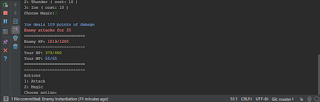
The biggest problem I'm finding is the same thing I bump into learning programming in the past: The further I go into it, the less in control I feel of the code and understanding what it does. All I have been doing mostly is copying almost verbatim the instructors code- although I do seem quick at finding typo errors when it doesn't run properly. I have also made my own changes to the program, such as making the text detailing enemy and player hp/mp stand out more, and giving different colours to the instructor (so text involving magic or MP are universally blue, for example).
I suppose these are the bugbears of learning anything unfamiliar. The thing is I know each of the systems individually and how and why they work. It's just, as a whole, I would have difficulty tracking down how or why a certain part of the code does a certain thing, without spending 30 seconds or so reading through it and remembering what each part of the code does. Still, the fact I can make little changes that work out how I want them to shows I must understand what I am coding on some level?
As usual, the code is available for study at: https://github.com/GlitchWalker/Python-RPG/
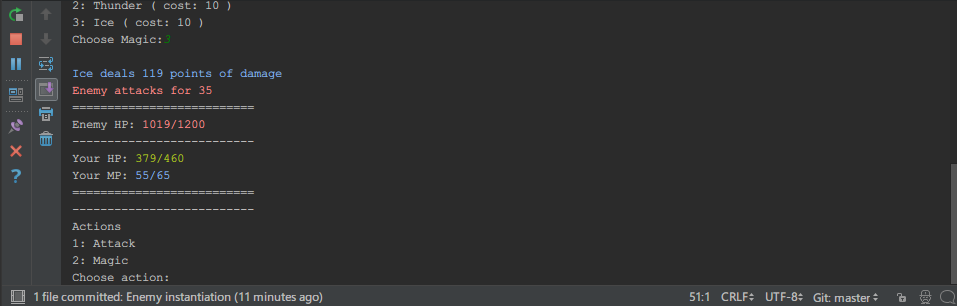
The biggest problem I'm finding is the same thing I bump into learning programming in the past: The further I go into it, the less in control I feel of the code and understanding what it does. All I have been doing mostly is copying almost verbatim the instructors code- although I do seem quick at finding typo errors when it doesn't run properly. I have also made my own changes to the program, such as making the text detailing enemy and player hp/mp stand out more, and giving different colours to the instructor (so text involving magic or MP are universally blue, for example).
I suppose these are the bugbears of learning anything unfamiliar. The thing is I know each of the systems individually and how and why they work. It's just, as a whole, I would have difficulty tracking down how or why a certain part of the code does a certain thing, without spending 30 seconds or so reading through it and remembering what each part of the code does. Still, the fact I can make little changes that work out how I want them to shows I must understand what I am coding on some level?
As usual, the code is available for study at: https://github.com/GlitchWalker/Python-RPG/
Thursday, 21 September 2017
My First Python App: The Vulgar Calculator
So I finally pulled myself out of a bit of a slump, and spent a (relatively) substantial amount of time learning the Python programming language (for those interested, it is the "Complete Python Course: Beginner to Advanced!" available at http://stackskills.com).
I name it "The Vulgar Calculator"; which is my programming equivalent of learning all the rude words when you first learn a foreign human language.

It is available on a GitHub repository I created to put my learning projects on, aptly named Python_Learnings).I will be (hopefully) uploading more of my projects there as I continue the course- the next project is to create a text RPG, which is actually pretty exciting and right down my alley!
Hopefully I will progress through it.
I name it "The Vulgar Calculator"; which is my programming equivalent of learning all the rude words when you first learn a foreign human language.
It is available on a GitHub repository I created to put my learning projects on, aptly named Python_Learnings).I will be (hopefully) uploading more of my projects there as I continue the course- the next project is to create a text RPG, which is actually pretty exciting and right down my alley!
Hopefully I will progress through it.


Wednesday, 12 March 2014
Metal Gear Solid: Ground Zeroes and why it is more than just a game
Now with Hollywood bad-ass Kiefer Sutherland at the helm as main protagonist Big Boss, you might be forgiven for assuming this "thinking man's" stealth/action game was going in the same direction of his world wide hit 24 (also, coincidentally, out this year).
From the first hints of this game, however, there were already glimmers that this would not be your typical all-American action game. "Nerd alert! Who would play video games that isn't under 12 years old!" You might think. But please, I invite you to read on.
For a start, it is made in Japan. And the opening shots of the very first trailer depicted the high-security military prison "Camp Omega"... A very clear nod to the real-world prison at Guantanamo Bay "Camp X-Ray". Where a child soldier is being held, having been apparently interrogated and tortured. And also where a female soldier has, apparently, had a bomb implanted inside of her... Necessitating an emergency operating procedure following rescue. Without anaesthetic. Following an (judging from a report a few months ago by the American Video Games Rating Board) already traumatic experience of sexual assault as a prisoner of war.
No, this isn't your typical action game. The "Metal Gear" series has always been one to tackle difficult and sensitive subjects; unique in an industry with budgets rapidly increasing to (and surpassing) those of Hollywood films. But first, some back story. This job isn't made much easier because of a storyline that could easily rival Lost in complexity. And to any pedantic geeks... Yes, I have glossed over a lot of the points on purpose to save this becoming an essay. The Metal Gear Series covers games set in the present day and prequels set around the era of the Cold War, and it is this part of the timeline I will be focusing on.
Set in 1974, Ground Zeroes is the first part of the two-parter "Metal Gear Solid V: The Phantom Pain", and follows the exploits of our main character with the code name "Big Boss". This was a code name given to him following a top secret mission in the Soviet Union where he managed to save the world from the brink of nuclear war; precipitated by the apparent defection of American Special Forces agent "The Boss" and former mentor of our hero (then known as Snake).
I say apparent, because our primary antagonist was herself undercover in order to obtain the Russian's share of a cache of funds amassed by the world's powers in the aftermath of World War 1 in order to try and prevent any kind of needless war from happening again. This mission all went wrong when her gift to a rival Soviet faction of a portable nuclear missile resulted in America having to explain an American-made nuclear missile being exploded on a Russian research base. In order to cover their tracks, the US government agreed to send one of their own agents in to assassinate her, as a show of faith they had nothing to do with it and that it was a "genuine" defection. The Boss was fully aware of this; and knew her mission was to allow herself to be killed at the hands of her former student.
After learning about this right at the end of that game, Snake was understandably a little bitter. He left the US army to set up and wander the world with a "rag tag set of mercenaries", using his army to fight for nations or peoples he believed to be the victims of US or Russian aggression in their proxy war. Things came to a head in Metal Gear Solid: Peace Walker, when the US government attempted to directly intervene with aggression in Nicaragua in order to stem the number of Soviet-friendly countries in Central and South America, areas the USA saw as it's "back yard".
It turns out the funding and snazzy off-shore base used to pay for Snake and his private army were provided by none other than another Soviet general wanting to make his mark in the world, using secret nuclear technology being developed in Nicaragua to destroy the base and army of Snake as well as assassinate him... By this point he had made himself a hero you see, and having him murdered and his base destroyed by a secret nuclear bomb from a secret US nuclear base would see an untold number of countries convert to communism, with much the same heroic imagery as Che Guevara.
Needless to say, Snake managed to overthrow this plot and, again, save the world from nuclear annihilation. But not before learning that the US had actually influenced the situation from the beginning, through a new intelligence agency known as "cypher". They needed an army and a situation to keep the world occupied, knowing the cold war would soon draw to a close and that the concept of "deterrence" would no longer keep America dominant in the new world. Cypher sought to gain dominance through information technology, and controlling the flow of information to eventually prevent war and ensure the superiority of the US in the coming generations. Refusing to accept being used, Snake gunned down the agent sent in to assess and sabotage his base. But not before acknowledging he had allowed his army without a country, intended for nations and peoples unable to fight or protect themselves, to interfere with the times and become a target themselves.
So at this point, Snake (now fully accepting his new title of Big Boss as a new start) is understandably very bitter towards any kind of government or order at this time. We also know that he becomes a major villain in the games set in the present day, and with the theme of "revenge" being continuously asserted in the advertising for the latest installments of the series this could well be the Metal Gear equivalent of Anakin Skywalker's transformation to Darth Vader in Star Wars.
With a unique tapestry of canon to draw on, including plot points regularly dealing with the betrayal of former soldiers by the state and government surveillance, a story like this could not be more apt at a time of NSA and government scandals across the world. I don't think there is a better time than now for video games to finally mature enough to deal with themes like child soldiers and rape within war, as a contrast to glorified violence in games like Call of Duty and Grand Theft Auto. From the trailers seen so far, this is one of those uncomfortable but unforgettable experiences in the same way as "12 Years A Slave". Maybe we could see a change in the coming decade of video games finally being seen as a serious art form.

Thursday, 28 March 2013
Theories on Metal Gear Solid V: The Phantom Pain

I think a line spoken to Meryl in the first of the MGS saga best summarises what we have seen in the "Solid" story so far: "The reality is no match for the legend".
More than just being different characters, I think the tales of Snake and Big Boss also fit into the catagories of The Legend and The Reality. By the end of Solid Snake's arc (MGS, MGS 2, MGS 4), we see Kojima has gone to great lengths to explain virtually everything that could possibly have been construed as supernatural (Mind Control, Telekinesis, A soul taking over another person, Hallucinations, and so on). This represents the "real", and even things that might not have needed an explanation have been tied up and fit into our world.. usually at some point involving nano machines.
In contrast, I feel the Naked Snake/Big Boss story arc (MGS 3, MGS: PO, MGS: PW, MGS V?) has, most of the time, almost gone out of it's way NOT to explain these events (The Boss' stitching flowing over her body like a Snake, the sudden change of colour of flowers following her death, Snake's "Boss Fight" with The Sorrow). I think the game indirectly hints at this by giving, not a Game Over screen, but a Time Paradox screen, occasionally even with Campbell telling you off for causing a time paradox. To me, it points to the idea that what we are seeing are not events that have actually happened, but rather a representation of those events. The legends passed down from one person to another; distilled as an interactive experience (either that we control directly, or that "someone" is experiencing as a VR mission).
I believe that the story/theme of Metal Gear Solid V is all about what happens when both of these "worlds" collide. Zero didn't just want another soldier, but an idol for the next generation. You could even take it further and say it's also about the battle of "Faith" versus "Facts"; is having an explanation for everything always the most suitable way to go forward? People lie about their loved ones to save them from the truth and to prevent harm (e.g. Snake lying to Naomi about Grey Fox's last words at the end of MGS). Conversely, has blind faith always led humanity down the best roads?
I believe this idea fits nicely with the fear of an "always on" society, and also the idea of information control from MGS2. Is what we see really the truth? Or is it censored to show someone elses truth? The gear on Snake's back from the phantom pain also suggests interference from Psycho Mantis. Could those shackles represent the same kind of control as the puppet strings from MGS4? Could this whole experience be Big Boss rejecting these implanted memories? Or this be the conclusion of a social experiment, like Raiden's story in MGS2, from Kojima to us to decide what is actually real?
Saturday, 9 February 2013
Final Fantasy XIII: Key Facts Review

Final Fantasy XIII is like a supermodel; astoundingly beautiful but with little substance.
Gameplay: The intention of Square Enix with Final Fantasy XIII was to strip away much of the complexity in order for the game to appeal to a new, younger audience. In a sense you could say they were successful. You now only control one character in battle, and the game does much of the actual "strategy" for you using what is called the "Paradigm" system. This controls the abilities available to other characters, similar to how the class system worked on Final Fantasy 5. For me the nail in the coffin, and in a sense what also appears to be the whole direction of the game, is the "Auto-Battle" menu item for your main character. Apart from the occasional time you need to micro-manage, you don't even need to think about strategy besides the paradigm anymore! The simplification is also reflected in the "exploration" of the world environment. By exploration I mean, of course, a linear path going from A to B via C (the odd enemy) with your reward being D (usually a cut-scene). Lather, rinse, repeat. Maybe this really is bringing the game to the barebones of what actually makes an RPG game fun, but for me I didn't feel grounded in a real world inhabited by people effected by real events. And as if to make more of a mockery of previous games and their fans, a huge explorable area is tacked on in the last quarter of the game, which bears little relation to the rest of the story or it's world. When in a conversation it came up that the game gets better towards the end, I don't consider playing 40+ hours to get to the best bits a plus points. Don't get me wrong, I'm not expecting the interactivity or freedom of Skyrim in a Japanese RPG. Indeed, in a JRPG what I look for is a more linear story with a non-customisable but completely relatable main character, as part of a wider world and storyline with a clear beginning, middle and end. But this isn't so much a game as an interactive movie. And I feel like I'm playing for 40 hours before I can finally get to a "World Map" for the first time.
Graphics: Hands down, this is the best part. The graphics are simply stunning, especially for a multi-platform game. Square Enix aimed to create a game that looked as good at the recent Final Fantasy VII: Advent Children, and it definitely doesn't disappoint. Character animation is fluid; the environments are highly detailed and with very decent effects. I also have not seen a graphical glitch through the entire game. Graphically, the game does everything it can to draw you into the world.
Sound: Besides the title screen music and the battle theme, the soundtrack for this game feels uninspired. This is pretty disappointing for a series which prided itself for the quality of its music. Tunes don't really feel like they are going anywhere; they are slow, and have a real anti-climatic feel to them. An even bigger knee in the bollocks (and yet more representative of the "populist" direction of the series) is the fact the main theme of the game was changed in English additions to some crap from a Leona Lewis album. Advertising for the game apparently point to her being a huge fan of it. She seems almost as in awe of the graphics as I was, so it must be legit! I can't understate enough how much something like switching a theme song for "localised" markets can have on the affect of the game. It damages the (in this game somewhat limited) build up of the game's soundtrack. Voice acting is also disappointing- they seemed to forgotten the lessons learnt from Final Fantasy XII and it's amazing voice talent to go back a step with miserable-sounding actors. And if I have to hear Vanille one more time, I swear it will mean the end to my TV.

Overall: If you can get it for £5, and you are a serious, serious fan of the old games and just have to buy this, then get it. For every other fan of the series, the experience will probably be too depressing. You'd be better off getting Final Fantasy VII: Advent Children

Monday, 7 January 2013
Fairer/More Local Policy on Wind Turbines
 |
| Windmills of the 21st century or hell on Earth? Photo by Lizzie |
I believe there is a very simple answer to all of this. Once a suitable site has been found, hold a referendum on whether it should be built or not. If there is a wide opposition from residents in the area, then they should be granted their request providing ALL residents reduce their energy expenditure in the space of 2 years, let's say by 20%. All residents should be able to receive free monitoring equipment to measure their energy usage.
More power stations are required because of the closure of old ones, and because our energy needs are increasing all the time. To me the argument on climate change is a moot point, compared to the very real threat posed by the dwindling of the world's fuel supplies, which will lead to ever rising costs for us all. If we are to take the views of residents opposed to wind farms seriously, then on behalf of the country they should be expected to play their part in reducing their use of energy.
EDIT: You can make your views known to Lincolnshire County Council by completing their questionnaire. You may be able to better express your views by calling their customer service centre on 01522 782226 or e-mailing them. You could also try tweeting them.
Please also sign this petition for renewable energy development in Lincolnshire on Avaaz.
Fairer/More Local Policy on Wind Turbines
|
| Windmills of the 21st century or hell on Earth? Photo by Lizzie |
I believe there is a very simple answer to all of this. Once a suitable site has been found, hold a referendum on whether it should be built or not. If there is a wide opposition from residents in the area, then they should be granted their request providing ALL residents reduce their energy expenditure in the space of 2 years, let's say by 20%. All residents should be able to receive free monitoring equipment to measure their energy usage.
More power stations are required because of the closure of old ones, and because our energy needs are increasing all the time. To me the argument on climate change is a moot point, compared to the very real threat posed by the dwindling of the world's fuel supplies, which will lead to ever rising costs for us all. If we are to take the views of residents opposed to wind farms seriously, then on behalf of the country they should be expected to play their part in reducing their use of energy.
EDIT: You can make your views known to Lincolnshire County Council by completing their questionnaire. You may be able to better express your views by calling their customer service centre on 01522 782226 or e-mailing them. You could also try tweeting them.
Please also sign this petition for renewable energy development in Lincolnshire on Avaaz.
Monday, 12 November 2012
Real stealth suit coming soon?

So, how long until we see an invisibility cloak like Harry Potter's, or Solid Snake's stealth suit? It seems to be much more difficult to create a suit that camouflages actual visible light waves than invisible to the eye microwaves, so it could be a while yet. However some other fairly convincing alternatives already exist in the world for the wannabe stealth operative/wizard.
Real stealth suit coming soon?
So, how long until we see an invisibility cloak like Harry Potter's, or Solid Snake's stealth suit? It seems to be much more difficult to create a suit that camouflages actual visible light waves than invisible to the eye microwaves, so it could be a while yet. However some other fairly convincing alternatives already exist in the world for the wannabe stealth operative/wizard.
Sunday, 11 November 2012
Hands off my phone!
 |
| The old technologies were always the best. Photo by @mararie on Flickr |
One of the worst sins of mobile telecommunications, however, lie in the ease of procrastination. If it wasn't bad enough sitting in front of a blank essay whilst having 300 tabs open in Firefox about the philosophy of Bostrom's simulation argument of life, now I can also sync these tabs to my mobile so I can continue reading whilst I'm away at the expense of finding a loved one's Christmas present.
There is one area where my phone has helped immensely, however; an area that to be honest makes everything else in life work like clockwork. And that would be my calendar. Without it and the ability to sync it online everywhere, I would forget even about doctor's appointments I'd only booked hours ago, let alone important birthdays or anniversary's. And for that alone, the other sins of Web 2.0 can be forgiven.

What on Earth has happened to Life with Playstation?
 |
| Life with Playstation ended in the first week of November |
Life with Playstation was an application that did software simulations on protein folding, and runs the FAH ("folding@home") software. The ways proteins fold (or rather, misfold) have been linked to all kinds of nasty diseases. Work is distributed across the millions of people with the software, which runs in the background on installed on PCs and Macs in order to test many different permeations and confirm each others results are correct. The PS3 version was slightly different in that it couldn't run as a background app, but had to be opened by the user for it to do it's calculations. Although this meant it didn't do work automatically, I did find it useful when I had background downloads and I needed to leave the system on anyway.
So what exactly happened? Some have reported that the folding@home project is coming to an end with the impression that the ending support and use of the application is the logical conclusion. The PS3 project is certainly over now (making it a self-fulfilling prophecy?), but recent posts on the folding@home blog stating they have a lot going on in pushing the envelope into new technologies and that they are really excited to see what the next 5 years bring don't seem to add up with this story. Additionally, work units are still coming up on my Mac application.
Maybe it was becoming too much work for Stanford University (hosts of the project) to support the Cell processor, and they were no longer getting as much in terms of computing power from the world's PS3s compared to the world's computers. Or maybe Sony became fed up of supporting software that didn't fit with it's ethos of instant entertainment. Either way I'm getting more and more frustrated with the applications and features dropped from the PS3 since launch. I'm also surprised Sony wouldn't want to support many of the other distributed computing projects in the world, such as those run on BOINC, an alternative to FAH that provides a common application for organisations to create distributed computing projects and users to join any of those organisations.
Anyway, I've fired off e-mails to the respective companies, and will update this blog with their answers.
Subscribe to:
Posts (Atom)